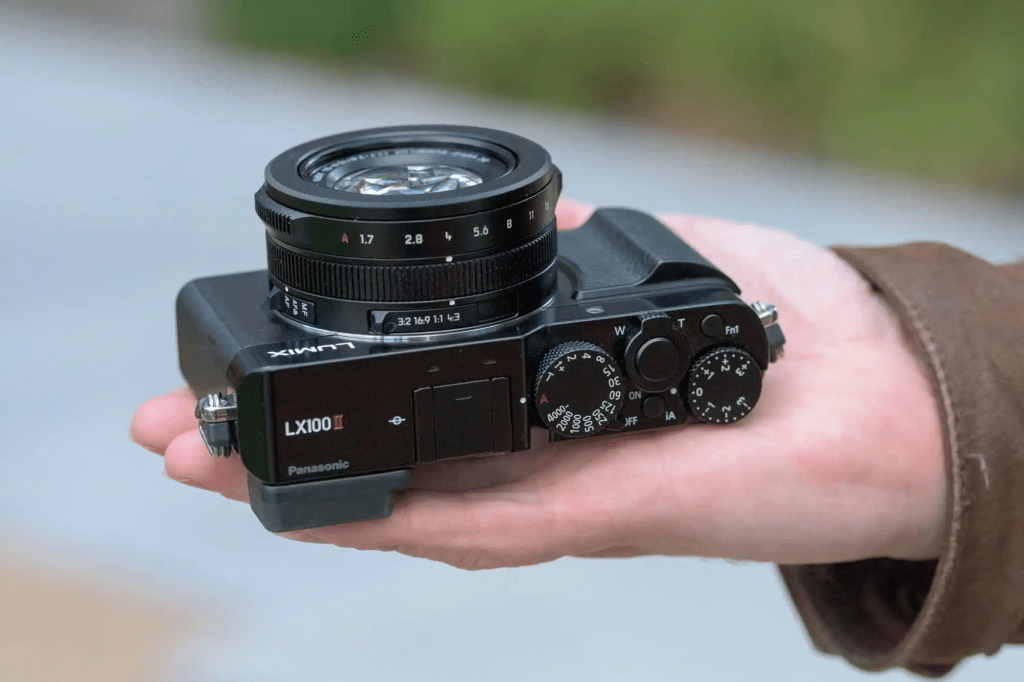
It might look a lot like its predecessor, but the Panasonic LX100 II offers a significant upgrade in image quality and generous performance in a take-anywhere body that’ll slip easily into your coat pocket. It’s perhaps not the best choice for video Insta 360 Camera price shooters, but still imaging fans will find lots to love, whether they prefer shooting raw or JPEG. And despite a compact body, there are generous controls and plenty of customization options to tune it to your tastes. Read on and find out if it’s for you in our in-depth Panasonic LX100 II review.
Pros
Compact coat-pocket friendly body with plenty of dedicated controls; Great electronic viewfinder; Impressive image quality for its class; Generous performance; Decent battery life.
Cons
Too big for a pants pocket; No articulation for LCD; Relatively short zoom range compared to some rivals; Can’t use full sensor area at any aspect ratio; Not the best choice for video.
Price and availability
The Panasonic LX100 II went on sale from October 2018 at a suggested retail price of US$999.99, which is about a $100 premium over the LX100 at its launch.
In late 2014, Panasonic made its debut in the large-sensor, compact camera market with the LX100, a coat pocket-friendly beauty that paired very good image quality with great performance. We came away from our LX100 review thoroughly impressed by what the company had achieved with its first entry in a brand-new category. Although we felt it could perhaps have been a little smaller and was left a little wanting in the resolution department, the LX100 had excellent ergonomics. It also boasted a great lens and viewfinder, and some really unusual features such as a true multi-aspect ratio design and support not just for 4K video capture, but also for extracting high-res stills in-camera. (4K capture capability is now commonplace in the market, but Panasonic’s cameras are still just about unique in their philosophy as regards aspect ratio. We’ll come back to that in a moment, though.)
Fast-forward to the current day, though, and while it has remained on sale for an extremely long time — and still at an impressive 2/3 of its original list price, at that — the LX100 is nevertheless starting to look a little long in the tooth in some respects. It was clearly about time for a replacement, and Panasonic has come through with a successor in the form of the LX100 II. While the two cameras are near-indistinguishable when placed side by side, the LX100 Mark II builds upon its predecessor’s design with improvements in several key areas.
LX100 II (left) vs. LX100
Externally, the most obvious difference between the two cameras (which are nearly identical in size and weight) is to be found in their handgrips. Where that on the LX100 was beveled towards the camera body at its top, that on the LX100 II now ends more abruptly with a sharp right-angle. And while the textured inlay on the handgrip is still faux-leather rather than the real thing, it now has a larger grain pattern that makes it look more natural.
And that’s about it for the visual differences, other than changes to the model number, silk-screening for a couple of buttons, and the absence of the ‘L’ (for Lumix) badge which used to sit tucked beneath the left side of the lens (when looking from the rear). The button labeling changes, meanwhile, repurposing the previous Filter and Wi-Fi buttons on the LX100 with two additional customizable Function buttons on the newer camera.
Our call for more resolution has been answered!
It’s on the inside where you’ll find the really important changes. First of all, there’s a brand-new, higher-resolution 4/3 image sensor, answering one of our few quibbles with the earlier camera. The new chip has a total pixel count of 21.77 megapixels, although the corners of the image sensor extend beyond the image circle of the lens, and so the actual image dimensions vary on both axes, depending upon the aspect ratio chosen. The highest resolution is around 16.8 megapixels in the 4:3 aspect ratio, and even the 1:1 aspect ratio mode offers up to 12.6 megapixel resolution. Native 3:2 and 16:9 aspect ratios are also available.
Output from the new image sensor is handled by Panasonic’s latest Venus Engine image processor which yields improved JPEG image quality, and despite the significant increase in resolution from the 12.7-megapixel maximum image size of the earlier camera, the LX100 II nevertheless offers up the same ISO 200-25,600 sensitivity range as did its predecessor. And just as in the earlier camera, there’s an extended sensitivity of ISO 100 available at the bottom end.
And together, the new image sensor and processor still allow burst capture at the same maximum rate of 11 frames per second, again despite the significant increase in pixel count. Enable continuous autofocus and that rate will fall to 5.5 frames per second, again just as in the earlier camera. However, a significant increase in buffer capacity means that despite the unchanged capture rates and higher resolution, you’ll now be able to capture over 50% more raw frames before the camera slows. (The LX100 was limited to about 22 raw frames in a burst, versus 34 frames for the LX100 II.)
The same lens we know and love
There’s one element of the imaging pipeline which remains unchanged, however, and that’s good news because it was a point which drew praise in our review of the earlier camera. The Panasonic LX100 II still offers up a Leica DC Vario-Summilux branded 24-75mm equivalent zoom lens on its front deck. As we saw in the LX100, this lens has a very fast f/1.7-2.8 maximum aperture across the zoom range, a nine-bladed, circular aperture diaphragm, Power O.I.S. image stabilization and can focus as close as 3cm (1.2 inches) at wide angle.
Product Image
And given that it’s the same lens, it offers the same good optical performance and swift depth-from-defocus autofocus technology that we saw in the earlier camera, too. For those of you not up on your jargon, Panasonic’s depth-from-defocus tech is an alternative to the more common phase detection, contrast detection or hybrid phase/contrast detection-based autofocus systems.
Like phase detection, it can quickly determine the distance and direction in which to focus, helping to avoid focus hunting that can be an issue with contrast-based systems. The depth-from-defocus system uses detailed information about the bokeh characteristics of the LX100 II’s fixed lens to determine that focus info without the need to either have a separate focusing sensor or on-chip focus pixels in place of imaging pixels on some parts of the main image sensor.
 Site Title
Leave a comment